
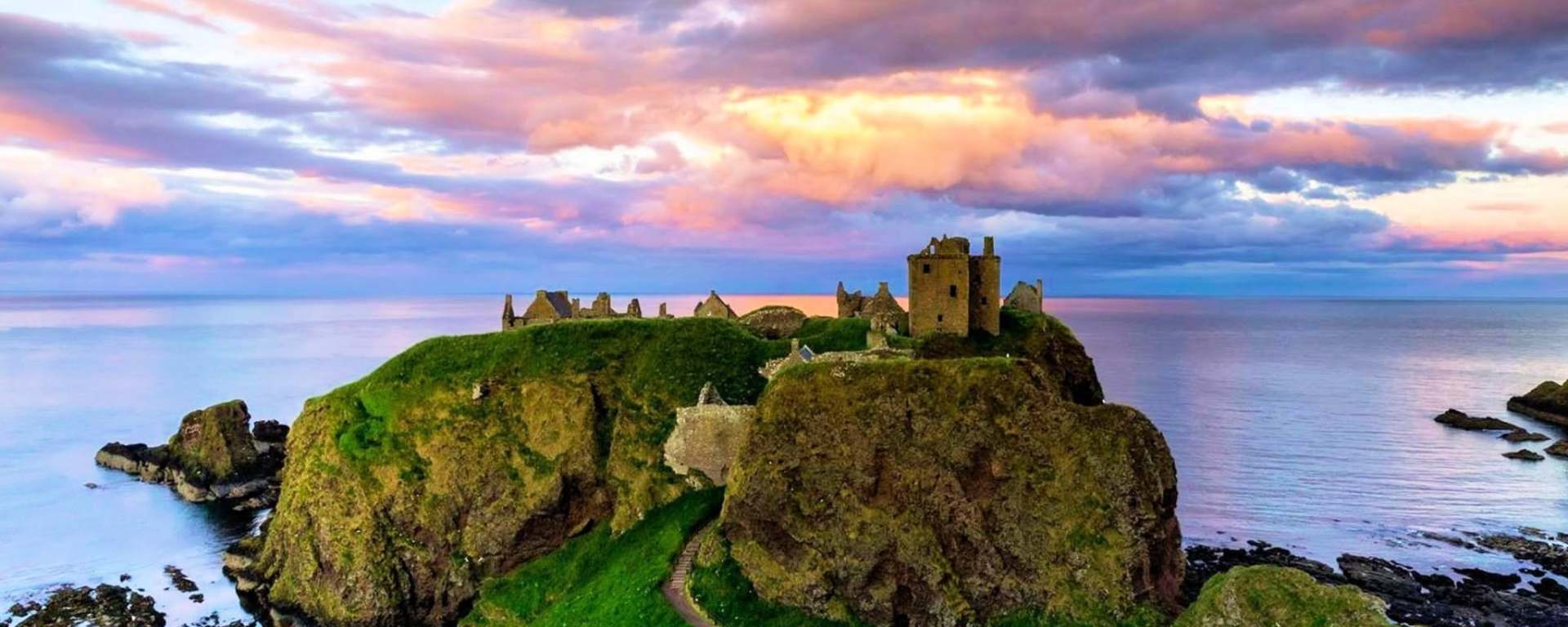
Scotland is home to many magnificent landscapes and medieval castles. With a history stretching back to the Early Middle Ages, it is also home to one of the fortresses that helped inspire the iconic Castle DunBroch from Brave.
The History of Dunnottar
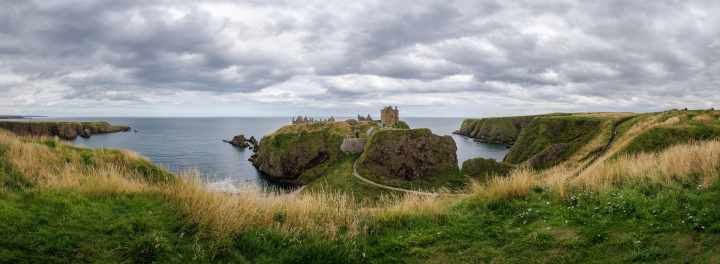
Dunnottar Castle, or Dùn Fhoithear in Scottish Gaelic, meaning “fort on the shelving slope,” is a fortress built on a rocky headland located on the northeast coast of Scotland.
Its history is believed to date as far back as the 5th century. Although it is unknown when the site was first fortified, its earliest written reference appears in the Annals of Ulster. Two sieges were recorded in the annals, one in 681 and the other in 694.
Historians believe these sieges likely refer to Brude, King of Fortriu, attacking the fortress in an effort to expand his influence along Scotland’s north-east coast. In the year 900, the first ruler to be called King of Alba, King Donald II died at Dunnottar at the hands of Vikings. In 934, King Æthelstan led an army into Scotland and went as far north as Dunnottar.
Dunnottar Castle is later mentioned in an early thirteenth century Arthurian romance where the hero Fergus must travel to Dunnottar to retrieve a magic shield. The story is called Roman de Fergus.
William Wallace captured Dunnottar from the English in 1297, according to poet Blind Harry. It occurred during the Wars of Scottish Independence. It is said that William Wallace imprisoned four thousand English people, making them prisoners of war, locked them in the church and burned them alive. Modern historians debate the accuracy of this story.
Around 1359, William Keith who was Marischal of Scotland, married Margaret Fraser, a niece of Robert the Bruce and acquired the Barony of Dunnottar. The lands, including the castle, were passed down to his daughter and son-in-law. The Keith family later regained full control of Dunnottar and finished the construction of the tower house. Due to building on consecrated grounds, Keith was excommunicated and had to write to Pope Benedict XIII after providing the parish with new grounds in Stonehaven. The excommunication was lifted and Dunnottar remained in the family until the eighteenth century.
In 1650, Oliver Cromwell attacked Dunnottar Castle and laid siege to the cliff-top fortress for eight months. His primary objective was to capture the Honours of Scotland (the Scottish Crown Jewels.) He also wanted the papers of King Charles II.
However, the castle stands isolated atop a 160-foot (49 metres) rocky headland overlooking the North Sea coast. The fortress withstood Cromwell’s artillery for eight months. Dunnottar Castle eventually surrendered in May 1652.
Oliver Cromwell proved unsuccessful at retrieving what he wished for. Before the castle capitulated, people were able to smuggle the Scottish Crown Jewels and hide them under the floorboards of the nearby Kinneff Kirk.
To this day, Dunnottar Castle still bears the marks of Cromwell’s siege which include broken parapets caused by his cannons.
Architecture and Defensive Design
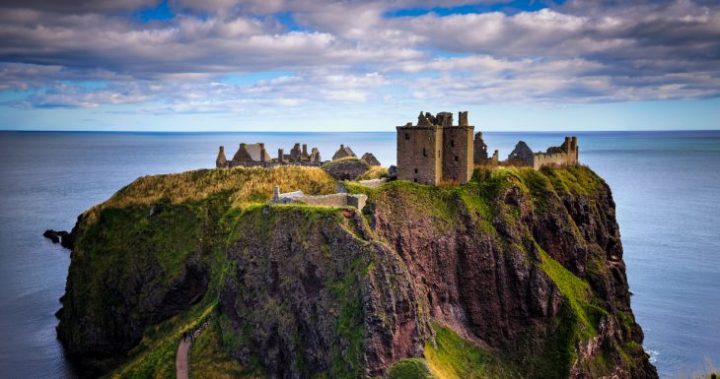
Dunnottar Castle was built atop a prominent rocky headland in Aberdeenshire, Scotland. Its sea cliffs plunge 160 feet (49 metres) into the North Sea on three sides. Located about 20 miles (32 kilometres) south of Aberdeen near Stonehaven, the fortress occupies one of Scotland’s most dramatic natural defensive positions.
For over six hundred years, the castle stood as a strategic Scottish fortress. The jagged sea cliffs provided a nearly impenetrable natural defence. Its towering cliffs continue to inspire awe today. The surrounding headland is an important habitat for seabirds, while the castle itself remains open to visitors.
Sea Cliffs
During times of siege, the steep cliffs concealed sea caves that may have been used for secret deliveries or escape routes.
The only access to Dunnottar Castle is via a single narrow, winding path designed with medieval defence in mind. The path descends a steep cliffside, crosses a tight walkway, and funnels into slender alleys, leading to the gatehouse.
When first built, the headland was connected to the mainland by a natural causeway. Medieval builders later cut through the rock, creating a deep defensive ditch that further isolated the fortress.
Gatehouse
Built by George Keith in the late sixteenth century, the Dunnottar Castle gatehouse was one of its strongest defensive features. The main gate was purposely built to block a narrow, natural cleft in the cliffs. This created a bottleneck, forcing attackers into a confined approach.
To deter invaders, the entrance was fortified. It had three tiers of splayed gun-loops and a portcullis, allowing defenders to repel attackers from above.
Curtain Walls
Visitors reach the curtain wall by following the steep approach to the Fiddle Head promontory, where the landward entrance is blocked by the fortress’s main defensive wall. Approximately 7.5 feet (2.3 metres) thick, the curtain wall completely sealed the narrow cleft leading into the fortress.
Palace
Built by Clan Keith in the 16th century, the palace is a clifftop building located in the northeast sector of the Dunnottar headland. Often called the Quadrangle, it features three wings housing stores, kitchens, a dining room, and a Great Chamber.
Compared to the cold, medieval fourteenth century keep, the palace building offered a more luxurious lifestyle. The keep or “Silver House” was the first stone fortification built on the site in 1392 by Sir William Keith. The L-plan tower was 13 feet (4 metres) thick, featured a spiral staircase, and stood three storeys high. It contained vaulted cellars for storage, a royal great hall, and private chambers.
Chapel
The chapel at Dunnottar Castle is the oldest surviving building. The rubble-built chapel dates back to 1276, when it was consecrated by William Wishart, the Bishop of St. Andrews.
Legend suggests that the site’s religious roots date back to the fifth century when an early Christian missionary named St. Ninian built a place of worship on the site.
Legends and Famous Events
William Wallace
During the Wars of Scottish Independence in 1297, William Wallace led a siege for the recapture of Dunnottar Castle from an English garrison. Legend says that Wallace and his men climbed the cliffs and took advantage of an unguarded postern gate to storm the castle. The legend continues with the burning of the soldiers inside the chapel.
The story of William Wallace at Dunnottar Castle is largely based on the fifteenth-century epic poem by the bard Blind Harry. According to him, the English soldiers were trapped and fled to the chapel, believing Wallace would not attack them on consecrated ground, but he showed no mercy and burned them alive.
The legend says that a twenty-seven-year-old William Wallace and his small troop of untrained men used the secret postern gate and caught the guards completely by surprise. It was a small, concealed opening near the cliffs known today as Wallace’s Postern.
Many of the gruesome details of this account, including the number of soldiers trapped inside the chapel and the climb up the cliffs, are considered part of Blind Harry’s romanticized narrative. However, the burning of the chapel is generally accepted as a historical event, while what happened inside it and the method of attack remain debated to this day.
Mary, Queen of Scots
Mary, Queen of Scots visited Dunnottar Castle twice. Her first visit took place in 1562, and she returned in September 1564, staying for two nights.
These visits took place during the height of the Queen’s reign. She travelled throughout the country to assert her authority and administer the turbulent Scottish nobility.
Inspiration for Brave
In 2012, Walt Disney Pictures released the animated fantasy adventure film Brave, originally called The Bear and the Bow, produced by Pixar Animation Studios. Brave was a success upon release, and Merida became the eleventh official Disney Princess.
Set between the tenth and twelfth centuries, the fairy tale takes place in the Scottish Highlands. It tells the story of Princess Merida of Clan DunBroch. She defies the age-old custom of marrying the son of one of the clans gathered to compete for her hand through archery.
Merida wants her freedom and to change her fate. To do so, she seeks the help of a wood witch who gives her an enchanted cake that turns her mother, Queen Elinor, into a bear. She has two days to transform the Queen back into herself with the sole clue left by the witch, “Mend the bond torn by pride.”
While mother and daughter grow closer, Elinor begins to lose her humanity. Merida must find the answer within her heart to save not only her mother, but the whole kingdom.
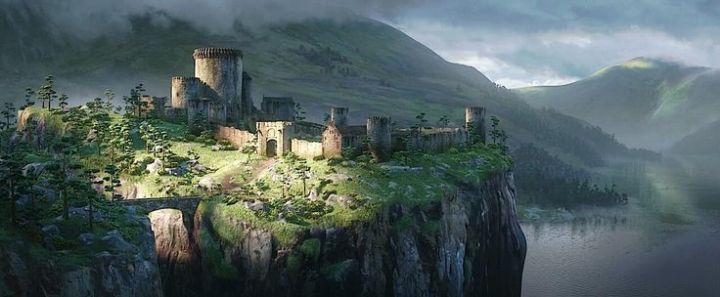
Castle DunBroch
The castle is designed to mirror the earthy simplicity of medieval Scotland. It doesn’t have the fairy tale luxury of other castles from later periods.
The castle was built for strength and strategy, as explained in the film, when the clans came together to defend their lands from people invading through the northern borders. The unyielding stronghold overlooks a fjord, and its sole connection to the mainland is through a single stone bridge.
DunBroch is home to King Fergus, Queen Elinor, Princess Merida, and the triplet princes Harris, Hubert, and Hamish.
The Great Hall
The room has the raised thrones of Fergus, Elinor, Merida, Harris, Hubert, and Hamish. It serves as a dining room and has an imposing fireplace. It is also a display room for King Fergus’ hunting trophies, including a black bear representing the demon bear Mor’du.
The Tapestry Room
It is the place where all tapestries are made. The DunBroch family tapestry, made by Queen Elinor, is hung on the wall and is later sliced by Merida during an argument with her mother over the gathering of the clans and her betrothal.
The Kitchen
Servants and cooks run around to prepare meals and sweets for the DunBroch family. Merida is shown grabbing apples there. Her triplet brothers always try to grab the sweets for themselves before and after meals. It has a door leading outside.
Other Rooms
Merida’s bedchamber contains her bed, a fireplace, and wall torches. She also has a chessboard and a window. This is where Merida vents her anger after learning about her betrothal and hearing her mother tell the legend of the princes.
The Royal Bedchambers are where King Fergus and Queen Elinor retire for the night. We see them together when Elinor does some needlework after her argument with Merida and Fergus tries to help her. We also see the room again when Elinor eats the enchanted cake and transforms into a bear.
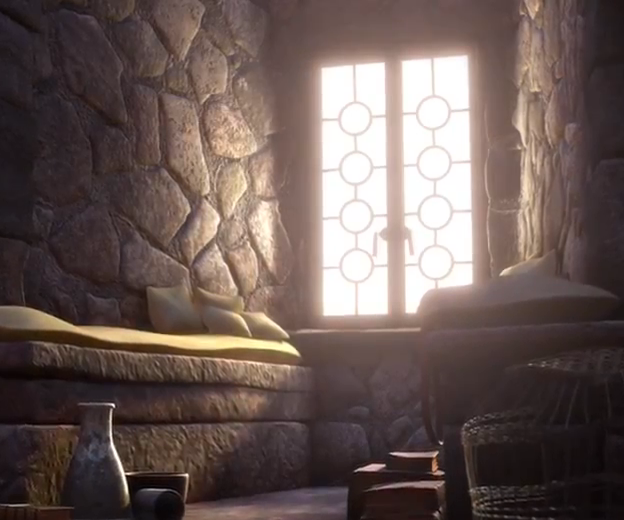
The classroom is where Queen Elinor teaches Merida everything she has to know as a princess who will someday become queen. We see Merida doodling while her mother teaches her geography. She also learns to play musical instruments.
The trophy room is where King Fergus keeps his taxidermy and hunting trophies.
The gatehouse is the main entrance in and out of the castle walls.
The stables are where Merida finds Angus and gives him oats and other treats. We see her retreat to the stables to see Angus after she was in an argument with her mother about the clans visiting for the festivities of her betrothal.
Other mentioned places and briefly seen rooms are the cellar, garden, and pens.
The Immortalization of a Castle
Dunnottar Castle and its dramatic cliffside location are sure to be admired for as long as they stand. Its history is rich and inspires people to dream of its glorious past.
Its beauty and uniqueness stood out so much that even Disney couldn’t resist its charm. National Geographic even confirmed that Dunnottar Castle was a crucial inspiration for the creation of Castle DunBroch in Brave.
Whether it is from taking photographs while visiting or watching the film Brave, the stronghold is forever immortalized in our memories.

