
The ancient art of marinating yourself in honey for the good of mankind, naturally.
Honey has long been celebrated for its preservative powers, jars of the stuff have been found intact in Egyptian tombs, still perfectly edible after three thousand years. But somewhere along the way, certain medieval minds decided that simply eating honey wasn’t ambitious enough. Why not become the honey? Why not dissolve, entirely and posthumously, into a golden elixir of healing? And so, dear reader, the mellified mummy was born.
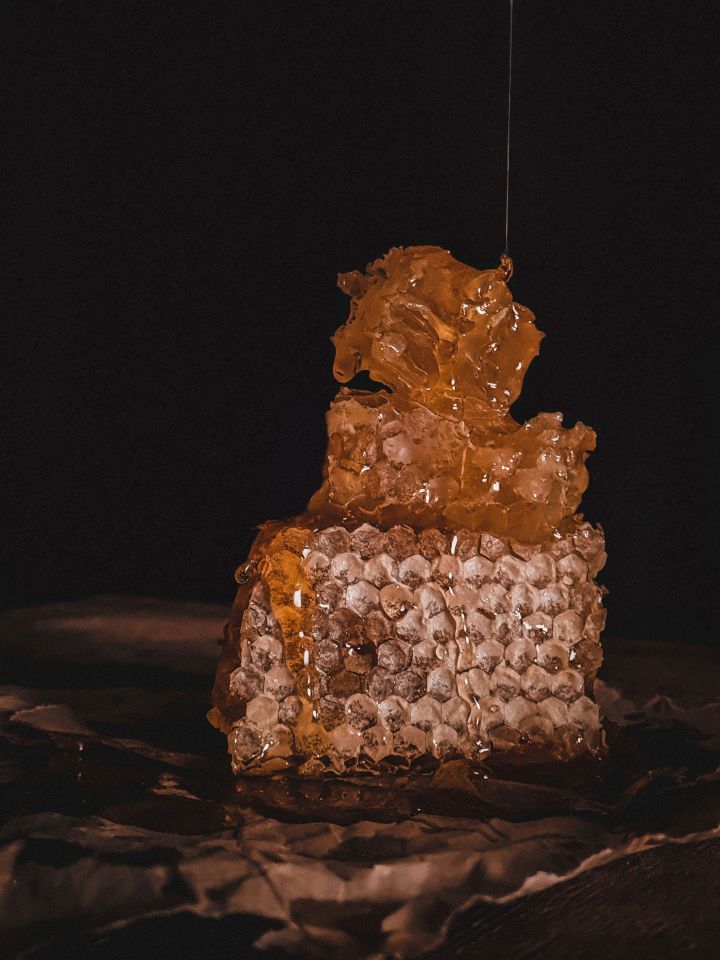
Known in Arabic sources as mummiya, this peculiar preparation is perhaps the most committed act of sacrifice in the history of folk medicine. The process began with a volunteer , elderly, infirm, and apparently in possession of extraordinary generosity of spirit. This individual would cease eating all food and instead consume only honey: honey to drink, honey to bathe in, honey massaged into every fold of aging skin. The idea was total saturation. The body, inside and out, would become a vessel of the sacred substance.
“Why simply eat honey when you could, over the course of a lifetime’s final chapter, become it entirely?”
When death inevitably arrived, hastened, one imagines, by the sheer monotony of such a diet , the body was not washed, mourned in the conventional sense, or prepared for burial as one might expect. Instead, it was lowered into a stone or wooden coffin filled to the brim with honey and sealed shut. There it would rest, undisturbed, for a century. A hundred years of slow, sweet dissolution.
The resulting substance which medieval Arab physicians described in texts with a kind of reverent clinical detachment was called mellified man. Small quantities were reportedly sold at tremendous price, prescribed for the treatment of broken bones, lacerations, and general afflictions of the body. Taken internally, dissolved in water or applied directly to wounds, this century-aged human confection was considered among the most potent remedies available to the wealthy.
Whether mellified mummies ever truly existed or were more legend than practice remains a matter of scholarly debate. The primary written account comes from the sixteenth-century Chinese encyclopaedist Li Shizhen, who recorded the practice from Arab sources with the same careful neutrality he afforded his other pharmacological entries. He did note, with admirable understatement, that such a preparation would be “difficult to obtain.” One suspects that finding willing volunteers presented its own logistical challenges.
“Taken internally, this century-aged human confection was considered among the most potent remedies available to the wealthy sick.”
What strikes the modern reader is not the grotesquerie of the remedy itself as history is well-stocked with those but the sheer patience it demanded. Every other quack cure in the annals of medicine promises fast results. This one asked you to wait a hundred years. The physician who prescribed it would never live to see the medicine made. The patient who consumed it was ingesting the faith of generations long dead. There is something almost poetic buried in that amber.
Honey, of course, truly is antimicrobial, genuinely preservative, and legitimately healing in certain wound-care applications. The mellified mummy may have been built upon a kernel of real observational knowledge, wrapped in layers of desperation, superstition, and the timeless human desire to believe that somewhere, at sufficient cost and sufficient strangeness, there exists a cure.
As for us? We’ll take the ibuprofen. But we’ll raise a small, uneasy toast to those ancient volunteers who gave quite literally everything and then some in the name of medicine.

