
For centuries, Sleeping Beauty has been celebrated as one of the world’s most beloved fairy tales. Yet beneath the enchanted sleep and true love’s kiss lies imagery that modern psychology finds surprisingly unsettling.
The Origins of Sleeping Beauty
The earliest known story resembling Sleeping Beauty appears in the anonymous French romance Perceforest. It was written in French between 1330 and 1344. Similar themes also appear in the Catalan poem Frayre de Joy e Sor de Paser between 1320 and 1340.
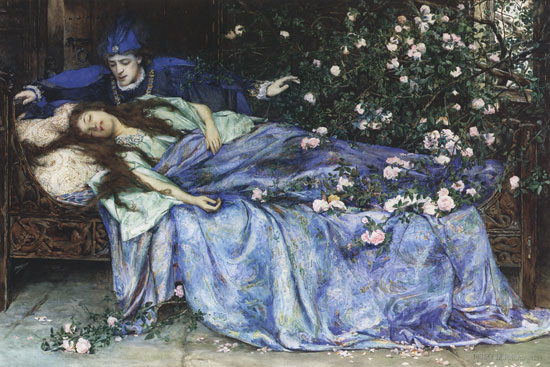
Between 1634 and 1636, Sun, Moon, and Talia was published in the Pentamerone by Italian author, Giambattista Basile. Scholars generally regard this as the first fully developed literary version of the story.
Charles Perrault then wrote La Belle au Bois Dormant in 1697 and it was part of his collection of Histoires ou Contes du Temps Passé. The fairy tale was divided into two parts that some scholars debate could have been two different tales.
The Brothers Grimm later adapted the tale, drawing from earlier oral traditions and likely influenced by Charles Perrault’s version. They added their own twists on the story, including the thorny rose hedge and the kiss.
The Fairy Tale We Think We Know
Perceforest (1330-1344)
The princess Zellandine is in love with a knight named Troylus. To prove himself worthy of her, her father sends him away to perform a series of tasks. She falls into an enchanted sleep while he is away.
When Troylus finds her, he has sex with Zellandine while she is asleep, and she becomes pregnant. She gives birth while still asleep and the boy sucks out the flax that caused the enchanted sleep. When she wakes up, she finds the ring left by Troylus and realizes he is the father. He later returns to marry her.
Sun, Moon, and Talia (1634-1636)
In the Giambattista Basile version of the tale, Sleeping Beauty is named Talia. When born, the great Lord asked astrologers to predict the future of his child. They warn him Talia will be endangered by a splinter of flax. When Talia is grown and by her window, she sees an older woman spinning. She is fascinated by the twirling of the spindle and invites the woman in. She takes the distaff and begins pulling the flax. The splinter gets under her nail, pricking her finger and she falls into a deep sleep.
While in her deep sleep, the king has her seated on a velvet throne. He believes her dead and leaves the house forever. A king walks by and has his falcon fly into the house. Nobody answers and so he climbs into the building through a ladder. When he finds Talia, he realizes she is alive and has sex with her while she sleeps, leaving her pregnant. He then leaves and goes back to his kingdom.
While asleep, Talia gives birth to twins. One of them sucks the flax from her finger. She wakes up to motherhood, unaware of what happened to her. One day, the king returns and finds the mother of his twins. He tells her what happened, and the two begin a relationship. The king must leave again but promises to return and bring her to his kingdom.
Back beside his wife at night, the king whispers “Talia, Sun, and Moon.” She threatens the secretary until he tells her the truth. Pretending to be the king, the queen sends a letter to Talia, asking her to send the twins. Upon their arrival, the queen orders the cook to kill the twins and serve them to the king. Instead, the cook hides them with his wife. He cooked two lambs, and the king enjoyed the food. Throughout the meal, the queen taunts him by saying, “Eat, eat, you are eating of your own.”
Afterwards, the queen invites Talia to the kingdom. Her intentions were to burn her alive The king hears of it and orders that his wife and those who helped her be burned, but rewards the cook. The story ends with a wedding between the king and Talia, and they lived happily ever after.
La Belle au Bois Dormant (1697)
Seven good fairies are invited to the christening of the king and queen’s long-awaited child. They are to be the princess’ godmothers and bless her with magical gifts. Each fairy received a golden box of bejewelled utensils. Because she had not left her tower in fifty years, an older fairy had been forgotten and was believed to be dead. She is given a box of plain utensils and hides behind the curtains, giving her blessing last.
After six of the fairies have bestowed their gifts on the princess, the forgotten one decides to put a curse on the princess and have her prick her finger on a spindle and die. The seventh fairy softens the curse, causing the princess to fall asleep for a hundred years instead of dying. She will awaken when a prince arrives.
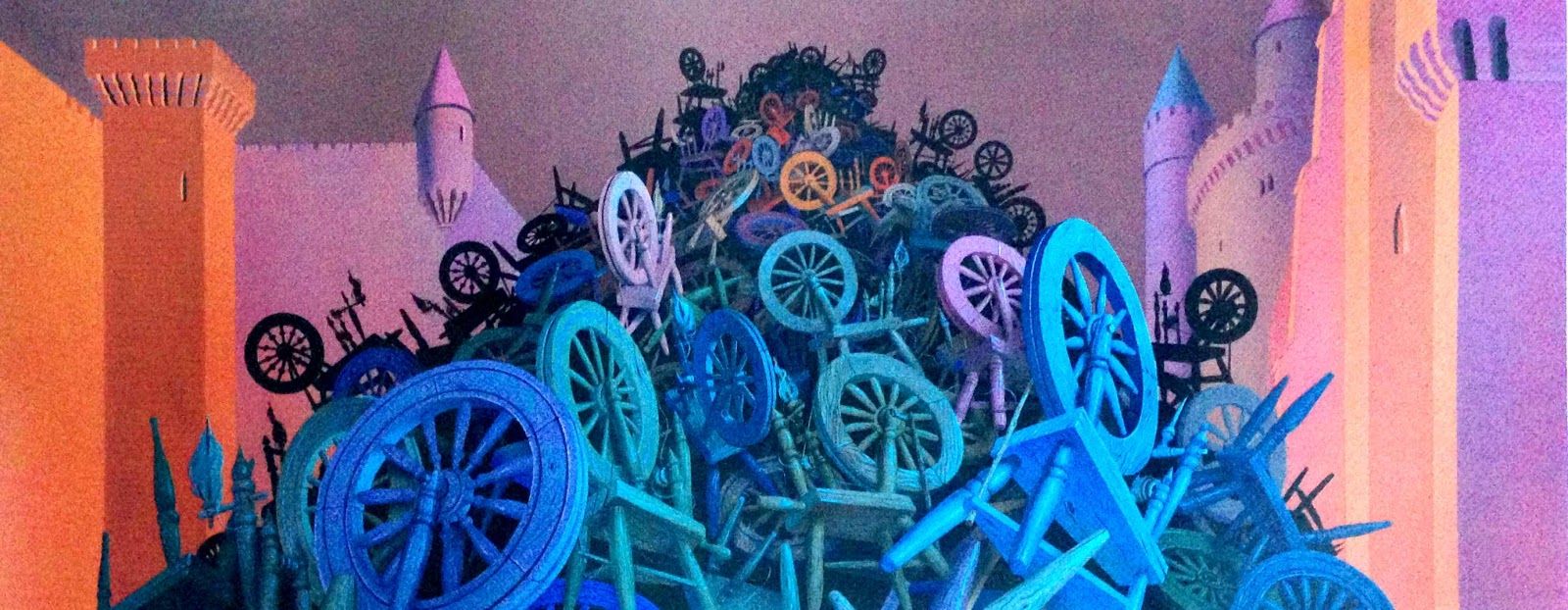
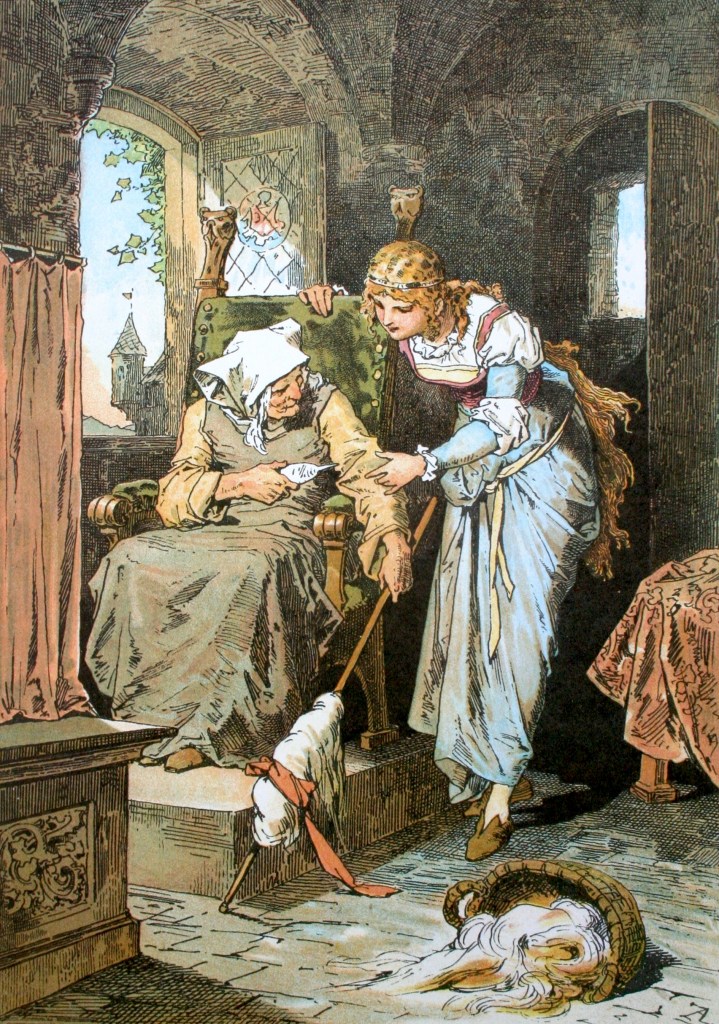
The king orders for all the spinning wheels in the kingdom to be destroyed to avoid the curse of the forgotten fairy. When the princess comes of age, she finds the forgotten fairy disguised as an older woman spinning at her wheel. She asks to try it and pricks her finger on the spindle. She immediately falls into the enchanted sleep.
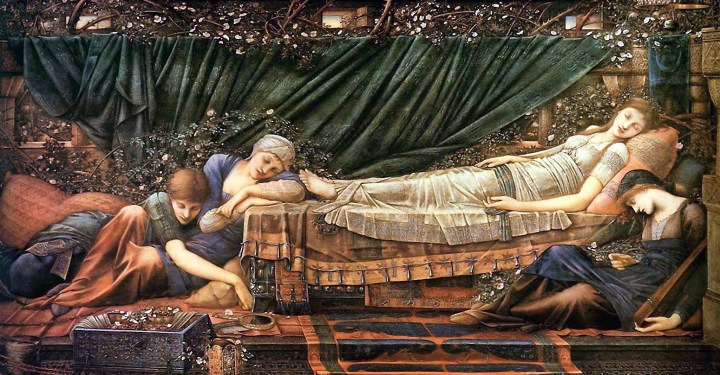
The king accepts that it was fate and has the princess placed in her bed. The last fairy foresees the princess awakening alone and frightened, so she casts a spell to put everyone and the animals in and around the castle to sleep, except for the king and queen. They kiss their daughter goodbye and the fairy has the forest grow around the castle, hiding it from the world.
One hundred years later, a prince comes across the hidden castle while on a hunting trip. He is told by an old man that a prince is destined to awaken the sleeping princess. The prince gets through the forest and finds Sleeping Beauty. His arrival breaks the spell, and the princess awakens. She gives him a look “more tender than a first glance might seem to warrant.” While they talk for a long time, the castle’s servants wake up and resume their work. Eventually, the prince and the princess are married in the castle’s chapel.
Their marriage was a secret and has the prince visit the princess for four years. She bears him two children, unbeknownst to his mother who is an ogress. The father dies and now the prince becomes the king. He brings home Sleeping Beauty and their two children, a daughter named Aurora and a son named Day.
The king has to go to war with his neighbour, Emperor Contalabutte. The Queen Mother is left to govern the kingdom. She sends Sleeping Beauty and her children to a secluded house in the woods. Her command to the cook is to bake Aurore in Sauce Robert for dinner. He substitutes the princess with a lamb. She then orders him to cook Day but switches the prince for a kid. The ogress orders him to serve Sleeping Beauty but a hind is substituted for her. The cook has reunited the princess with her children who have been hidden by his wife.
When the Queen Mother discovers what the cook has done, she prepares a tub in the courtyard and fills it with vipers and other venomous creatures. When the king comes home unexpectedly, the ogress is exposed and throws herself in the tub. She is eaten alive by the creatures.
Then the king, queen and children live happily ever after.
The Little Briar Rose (1812)
The primary difference in the Brothers Grimm version of Sleeping Beauty is that the princess awakens when the prince kisses her after the hundred years have already ended. The kiss coincides with the spell ending rather than explicitly breaking it. Unlike Charles Perrault’s version, it ends with the princess awakening and the couple living happily ever after.
Word of Warning
It is important to distinguish literary symbolism from clinical psychology. Fairy tales are not psychiatric case studies, and there is no evidence that Giambattista Basile, Charles Perrault, and the Brothers Grimm intended to portray somnophilia. However, psychologists and modern readers have observed that certain images within the story resemble themes associated with somnophilic fantasies, particularly the idealization of a beautiful, motionless, unconscious body.
Sleeping Beauty Is Not Simply Sleeping
In each version of the fairy tale, Sleeping Beauty is not simply sleeping; she is under a spell that keeps her unconscious. Whether it is the flax or the spindle, the princess is kept in slumber and cannot give consent.
To everyone around her, Sleeping Beauty is completely unresponsive. In the Giambattista Basile version, her father believes she is dead and leaves the house forever, leaving her on a velvet throne. This emphasizes just how completely passive she has become.
Sleeping Beauty is closer to a coma than sleep. In the Charles Perrault and Brothers Grimm versions, the princess is first cursed to die when pricking her finger on the needle of a spinning wheel, but then the last fairy softens it by making her fall asleep. It is an enchanted sleep rendering her unconscious.
Psychologically, that distinction matters. Sleeping Beauty is not resting. She is entirely unaware of the world around her and incapable of responding to it.
The Hundred-Year Sleep
In the Charles Perrault and Brothers Grimm versions, Sleeping Beauty’s curse of death is softened into a hundred years of enchanted sleep. While no one can know for certain why the authors chose a hundred years instead of a single day, we can speculate on what that length of time symbolizes.
The fairy does not leave Sleeping Beauty to face her fate alone. Instead, she places the entire kingdom under the same enchanted sleep, including its animals. Time is suspended, and the princess represents untouched youth. Her innocence is then unspoiled. Nothing changes around her except the passage of time itself.
On her bed in a castle overgrown with thorns and vegetation, Sleeping Beauty rests in her eternal beauty. She remains preserved for a hundred years, untouched until the prince arrives or kisses her, depending on the version.
Sleeping Beauty is frozen in time, not dead, not quite alive, but in-between.
The Prince and Somnophilia
In the early Sleeping Beauty tales Perceforest and Sun, Moon, and Talia, the knight and king find the princess alive but unresponsive before having sex with her. That particular behaviour has raised eyebrows among some readers, who draw parallels between this conduct and somnophilic imagery.
In these fairy tales, the princess is rendered unconscious and kept in an enchanted sleep where she cannot give consent. The king’s and the knight’s attraction to Sleeping Beauty’s idealized beauty compels them to have sex with her. Their actions therefore suggest an attraction to a sleeping body.
In The Little Briar Rose, the prince finds Sleeping Beauty and kisses her to awaken her from her enchanted sleep. The true love’s kiss seems to be magical in the Brothers Grimm fairy tale. Even so, the princess has not consented to the gesture, despite it ending the spell.
The parallels to somnophilic imagery lie not only in Sleeping Beauty’s complete passivity, but also in her frozen beauty. She is also alive despite being unresponsive. The knight, king, and prince do not appear troubled by the fact that the princess cannot give consent.
Beauty Frozen in Sleep
One of the biggest themes in Sleeping Beauty is that the princess’ enchanted sleep prevents her from aging. She will never change and will always appear the same. Her state of unconsciousness allows her to remain untouched. Her beauty remains intact.
Sleeping Beauty is an embodiment of innocence and purity. She cannot verbalize anything or reject anyone. She becomes a vessel for eternal youth. Her innocence is forever preserved. But she is also forever waiting to be awakened.
It is the sum of these themes that has captivated readers for centuries. It is not only Sleeping Beauty’s physical appearance that is alluring, but her suspension in time.
After all, the princess is stronger than anyone gives her credit for as she assumes the mantle of queen not long after awakening to a life she has no recollection of. And if we base this on the Charles Perrault and Brothers Grimm versions, she awakens a hundred years in the future as an orphan.
Disney Softened the Horror
In 1959, Disney‘s animated musical adaptation Sleeping Beauty premiered in theatres. Disney reworked Charles Perrault’s and the Brothers Grimm’s versions of the fairy tale into a film that would define Sleeping Beauty for generations to come.
Upon its re-release, Sleeping Beauty became a masterpiece, and the film redefined the fairy tale altogether. With its pre-Renaissance inspired tapestry and softened fairy tale retelling, Aurora became the third official Disney Princess.
Aside from Aurora pricking her finger and falling into a coma-like sleep, very little remains from the Perceforest and Giambattista Basile versions. Themes of sexual assault, cheating from the king, and unsuspected motherhood are left aside to instead favour love above all, from Aurora’s parents, the fairy godmothers and the prince.
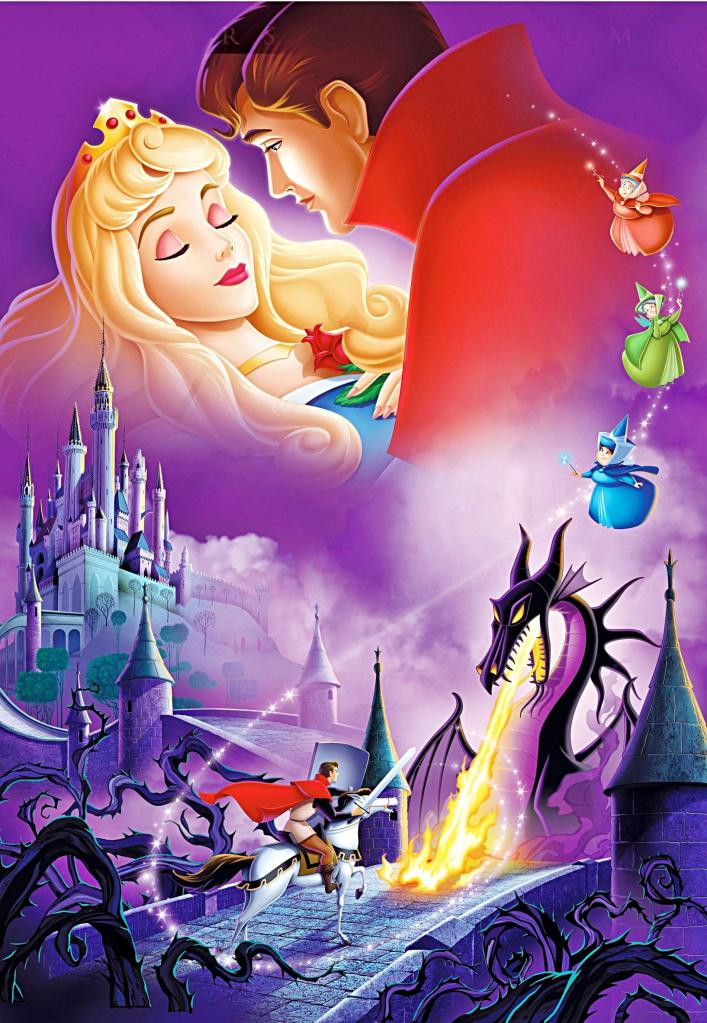
In the Disney adaptation, King Stefan and Queen Leah are a bigger part of the story. Especially King Stefan who is friends with Prince Philip’s father, King Hubert. They remain part of Princess Aurora’s life when the curse is fulfilled, and they fall asleep under the good fairies’ spell. Unlike Charles Perrault’s version, where they leave before the curse takes effect.
Another change comes from the seven fairy godmothers being reduced to three, Flora, Fauna, and Merriweather. They play a much bigger role as they raise Aurora as Briar Rose in the forest, a clear nod to Charles Perrault and the Brothers Grimm. They relentlessly protect the princess, despite the curse taking place regardless of their efforts. They save Prince Philip and guide him through his journey to Aurora.
The biggest change comes from the forgotten fairy who cursed the princess. Disney gave her a name that will become iconic: Maleficent. She is a crucial part of the story. In the film she doesn’t stop at the curse, she actively tries to have Aurora prick her finger. And to stop any chance at her awakening, she captures Prince Philip.
The scene where Maleficent morphs into a dragon to fight Philip became one of the most recognizable movie moments in Disney history. The good fairies give the prince the sword of truth and the shield of virtue to defeat Maleficent, widely regarded as an unstoppable dark fairy. In a desperate attempt, Prince Philip throws the sword of truth to Maleficent’s heart and kills her.
Borrowing the magic of true love’s kiss from Snow White, Prince Philip finds Aurora and kisses her to awaken her. A choice kept from the Brothers Grimm version. Aurora opens her eyes and sees Philip who she met before in the forest, and both were captivated by one another.
It ends with Philip reuniting Aurora with her family. The couple then dance together, implying they lived happily ever after.
The second half of Charles Perrault’s fairy tale is completely unused. The prince is not the son of an ogress and doesn’t hide the princess from anyone. The hundred-year sleep is reduced to a short time lapse. Themes of cannibalism are left aside and for the better of the story Disney wanted to tell.
Aurora remains one of Disney’s most misunderstood princesses. She is seen by a broad audience as passive, naïve and innocent. While she is kind-hearted, Aurora was deceived her whole life, raised as a commoner in the forest, sheltered from the world. The good fairies only revealed to her she was a princess on her sixteenth birthday, including that she was betrothed to a prince from her birth.
The princess had to come to terms with that revelation in an instant. She would go from a secluded life in nature to a royal court surrounded by people. The weight on Aurora’s shoulders is heavy. She doesn’t know her parents that are the king and queen of a kingdom. She is unaware that she is cursed and that her life depends on true love’s kiss.
In conclusion, Aurora is much stronger than the movie leads us to believe.
Final Thoughts
Sleeping Beauty’s curse does more than suspend a life, it suspends choice itself.
Whether viewed through folklore, literary symbolism, or modern psychology, Sleeping Beauty remains far darker than many remember. The enchanted sleep does more than pause a princess’s life. It preserves one of storytelling’s oldest and most unsettling questions: why has perfect beauty so often been portrayed as silent, passive, and waiting to be awakened?

