
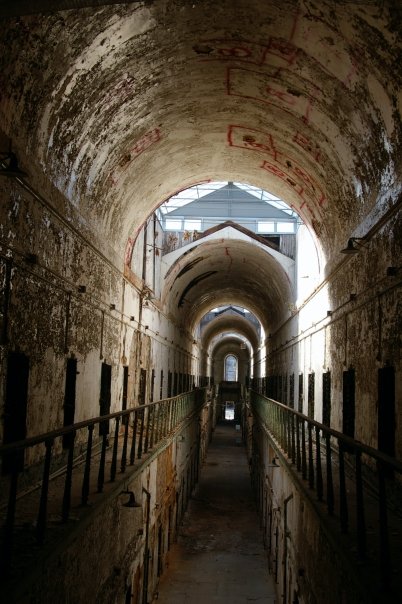
Eastern State Penitentiary is considered to be the world’s first penitentiary prison, built in 1822 near Philadelphia, PA. Today, we explore its eerie design and history.
In the early 1800s, a penal code debate raged across the United States, and at its core was the same question that we still wrestle with today: punishment or rehabilitation? The state of Pennsylvania was one of the earliest in advocating for rehabilitation-based reform using separate incarceration. Though the method was experimental, Eastern State Penitentiary (then called Cherry Hill Prison) was opened on October 25th, 1829, for male inmates only.

One thing to keep in mind, however, is that in the 19th century, rehabilitation-based reform was far crueler than it sounded. Rehabilitation had nothing to do with the prisoners themselves and everything to do with their immortal souls. In this system, inmates were put in solitary confinement to contemplate their sins, or to do penance—the concept that lent the penitentiary style of prison its name.
The doors to the prison cells were unusually short: some said that this was to make it harder for inmates to escape or attack guards, but others said that it was to force inmates to bow in contrition.
The prison itself has a radial floor plan, with the seven cell blocks laid out from the central office like the spokes of a wheel, allowing for constant surveillance from the hub. The halls had high vaulted ceilings with Gothic windows at the ends. Architect John Haviland specifically aimed to give the halls the feeling of a church. The cells themselves were completely made of concrete, except for a single glass skylight to represent the “Eye of God”, reminding prisoners that God was always watching.
Outside each cell were individual areas for exercise, walled off to prevent communication between prisoners. Exercise time was also set to an extremely strict schedule to ensure that no two prisoners in adjacent cells would be outside at the same time. Any time a prisoner left his cell, he would always be accompanied by a guard, and he would have his head wrapped in a hood to prevent other prisoners from recognizing him. The cells themselves had a two-door mechanism, with a metal door on the cell side and a wooden door on the hall side to muffle noise. Inmates were also forbidden to speak and given a number to identify them as soon as they arrived. There was no common area. Meals were given to each prisoner through tiny holes in the doors.
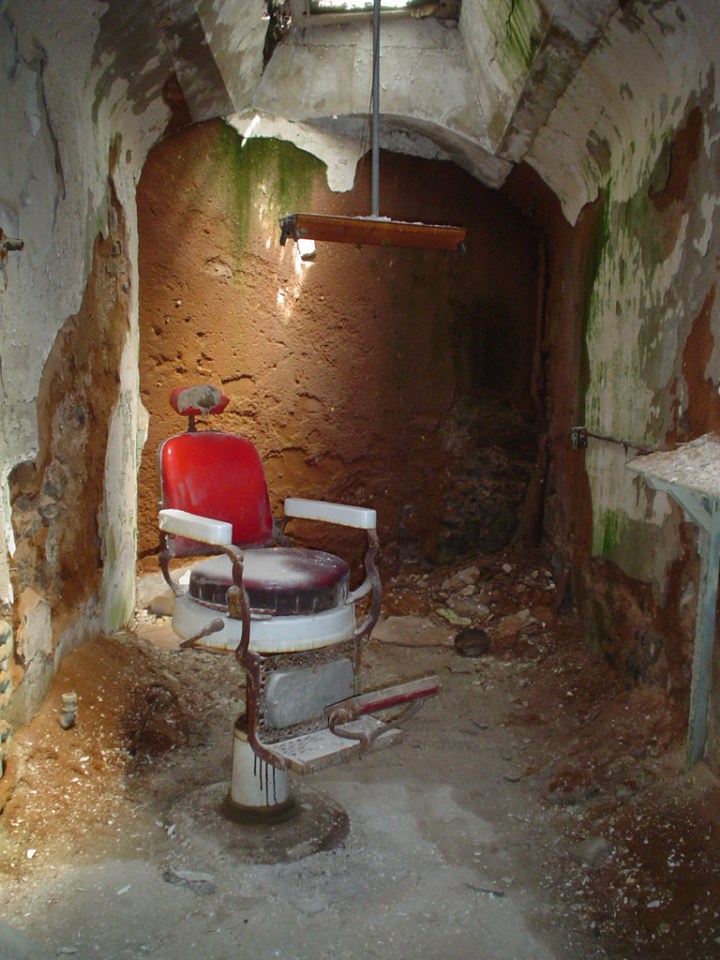
This extreme isolation was criticized heavily. The Auburn system was developed contemporaneously as a counter to the Pennsylvania system, and it proved on the whole to be more popular across the United States. Sing Sing is an example of the Auburn system. John Neal, a staunch activist, pointed out the irony in the United States being “renowned throughout the whole earth for her prisons” only a few decades after the American Revolution and its principles of freedom and equality. Charles Dickens decried the system as torture. They weren’t wrong: rather than inducing remorse, prisoners often fell into despair, mental illness, or even self-harm.
Tragically, this system did not collapse because of immediate opposition or reform. Its undoing was its own design. There were simply too many prisoners for solitary confinement to be a viable system, as most of the early prisoners were petty criminals. The first three wings of the prison were at maximum capacity before construction of the remaining four was even complete. By the early 20th century, second stories were added to the cell blocks to counteract overcrowding. The solitary system was abandoned in 1913, and for its final years, it operated as a congregate prison.
It was not enough. The prison ceased operations in 1971, to nobody’s particular dismay. The site was purchased by the city of Philadelphia and left to rot until 1988. The Eastern State Penitentiary Task Force successfully petitioned then-mayor Wilson Goode against redevelopment, and the prison opened to the public as a historical site in 1994. It now holds the title of U.S. National Historic Landmark, and it is open for tours today.

