

Ring and Dark Water author Koji Suzuki, one of the defining figures of J-horror, has died at 68.
On May 8, 2026, Koji Suzuki passed away at a Tokyo hospital at the age of 68. The horror world lost one of its most quietly revolutionary architects: a man who, almost by accident, rewired the global imagination for fear.
He was born in Hamamatsu in 1957, studied French literature at Keio University, and spent his early years bouncing between odd jobs, including stints as a cram schoolteacher where, by all accounts, he kept students rapt with his gift for terrifying storytelling. It was an unlikely beginning. Despite the moniker given to him by critics of “the Stephen King of Japan”, he was reportedly not even a devoted fan of horror fiction. He simply understood, on a profound instinctual level, what made people afraid.
His debut novel Rakuen (Paradise) arrived in 1990 and earned him a superior prize at the Japan Fantasy Novel Awards. Then came Ring.
Published in 1991, Ring tells the story of a cursed videotape that kills its viewers exactly seven days after watching. What sounds like a fairly conventional supernatural premise becomes something far stranger and more unsettling: a meditation on transmission, on the unstoppable spread of dread, and on the intimacy between a story and the person receiving it. The novel spawned a multimedia franchise (Hideo Nakata’s landmark 1998 film adaptation Ringu, Gore Verbinski’s 2002 American remake, sequels, manga, television series, video games, and even a Dead by Daylight DLC), and in doing so, planted a flag for Japanese horror on the world stage.
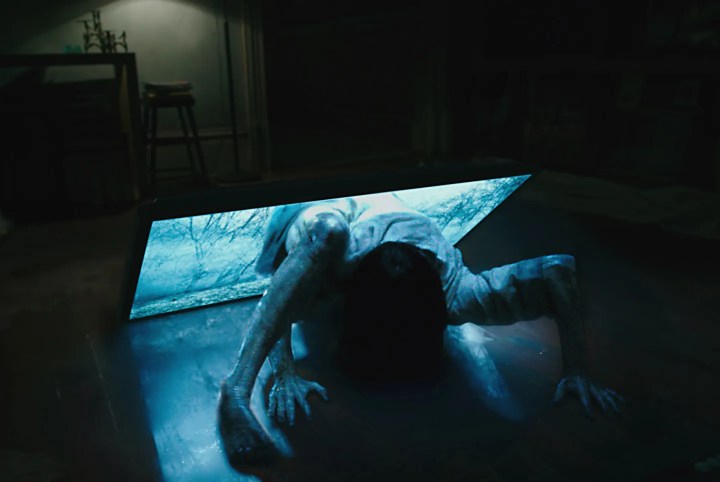
Sadako, the pale, black-haired onryo at the novel’s center, became arguably the most recognizable figure in modern horror mythology. She did not need a weapon or a motive in the conventional sense. She needed only to be seen, and then, seven days later, she arrived. In giving the world Sadako, Suzuki gave horror a monster built from pure dread, from the terror of inevitability itself.
Ring was only the beginning of his Ring universe. Spiral (Rasen), which won the Yoshikawa Eiji Prize for New Writers, and Loop followed, expanding the mythology in directions that veered boldly into science fiction and existential philosophy. His short story collection Dark Water offered quieter, more intimate horrors, and the title story was adapted into the acclaimed 2002 film by Nakata, followed by an American remake in 2005. Beyond the Ring universe, Edge earned him the Shirley Jackson Award, making him the first Japanese author to win the prize for Best Novel. In 2021, the Horror Writers Association honored him with the Bram Stoker Award for Lifetime Achievement. His final novel, Ubiquitous, was published in 2025, a return to horror, with an English translation reportedly underway.
What made Suzuki singular was not just the monsters he created, but the philosophy underneath them. He understood that the most potent fear is the fear of something spreading that cannot be outrun or undone. In the age of the internet, of viral content, of information that cannot be unlearned, Ring feels less like a horror novel and more like a prophecy.
He reportedly lived well: sailing, riding motorcycles across America, visiting the homes of his literary heroes. He was bemused by his own legacy, and perhaps that distance is part of what kept his work so clear-eyed. He loved people, and the specific, fragile architecture of human dread. He is survived by his family and by a body of work that has both shaped the nightmares and sparked the imaginations of millions.

