
Picture this: it’s the middle of winter in New Zealand. You’re rugged up on the couch in your best black hoodie, doom-scrolling TikTok while the rain hammers the windows. And there, between a satisfying slime video and a Tauranga café review, an absolute unit of a medieval torture device appears on your screen. Welcome, my ghoulishly curious friends, to the very strange second life of the thumbscrew or as history’s more dramatic corners prefer to call it, the Devil’s Handshake.
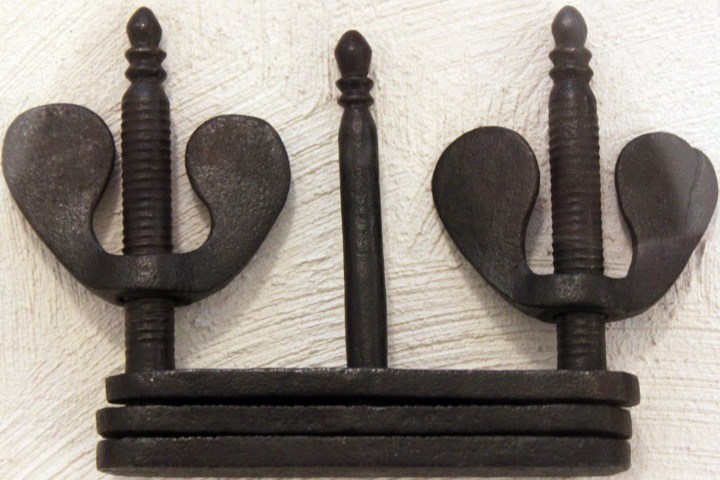
The name alone earns it a permanent seat at the dark academia table. The thumbscrew was a deceptively simple instrument of torment: essentially a vice for the hand, designed to crush fingers or toes with cold, mechanical precision. A central screw allowed the torturer to apply and control pressure with almost bureaucratic calm, a little twist here, a little twist there while the victim’s bones gave increasingly loud opinions on the matter. Many models were lined with studs or ridges on the inner plates, ensuring that even before things got truly structural, the experience was already unforgettable in the worst possible way. At full force, the device could shatter bones entirely. One bad meeting in a cold stone room and your lute-playing career was categorically over.
Used throughout medieval and early modern Europe, the thumbscrew was the go-to accessory of interrogators who fancied themselves patient. Unlike more theatrical instruments of suffering, this one offered modulation. You could ease off. You could let hope bloom, briefly. Then continue. It was psychological as much as physical and that cocktail of dread and precision is exactly what makes it so enduringly fascinating to history nerds, horror lovers, and yes, your average darkly-inclined New Zealander who just wanted something interesting to watch before bed.
Fast-forward to the present day…
TikTok, that chaotic museum of human curiosity, has given the Devil’s Handshake a whole new audience. Creators are sourcing replica thumbscrews, beautifully grim little metal contraptions and testing them on camera. Some brave souls apply them to their own fingers, pressing just to the point of serious discomfort before backing off. Others use dummy hands to demonstrate exactly what full pressure would do to bone and soft tissue. The comments, predictably, are a spectacular mixture of fascination, wincing, and people tagging their mates with a single skull emoji.
And here’s the thing that this New Zealand geek-goth absolutely adores about this trend: it’s doing genuine history work. There’s something powerful about seeing a replica in someone’s actual hands feeling, even vicariously, the weight and mechanism of it – that no textbook photograph quite manages. The thumbscrew stops being an abstract object behind museum glass and becomes real, tactile, and deeply uncomfortable in the best educational sense. It’s dark heritage content, and it slaps.
From the dungeons of medieval Europe to the algorithmically-curated feeds of Kiwi teens watching in Wellington lounges “The Devil’s Handshake” has taken quite the journey. It never really asked for a digital renaissance, but then again, the best bits of gothic history never do. They simply wait, patient as a screw slowly turning, until the culture is ready to look again.
Some things, it turns out, never quite lose their grip.

