
The witch trials occurred when everyone could be a victim of accusations leading to torture and horrible deaths. But some of the worst stories of witchcraft lead to Scotland, and Agnes Sampson is one of them.
The History Of Agnes Sampson
Agnes Sampson was a widow and mother who lived in Scotland. She was mainly a healer and a midwife. There is little information on her life or documentation as a citizen because Agnes was the village’s healer and midwife. She was a kind person who kept to herself, most likely, but she was the perfect scapegoat: woman, older, widow, healer.
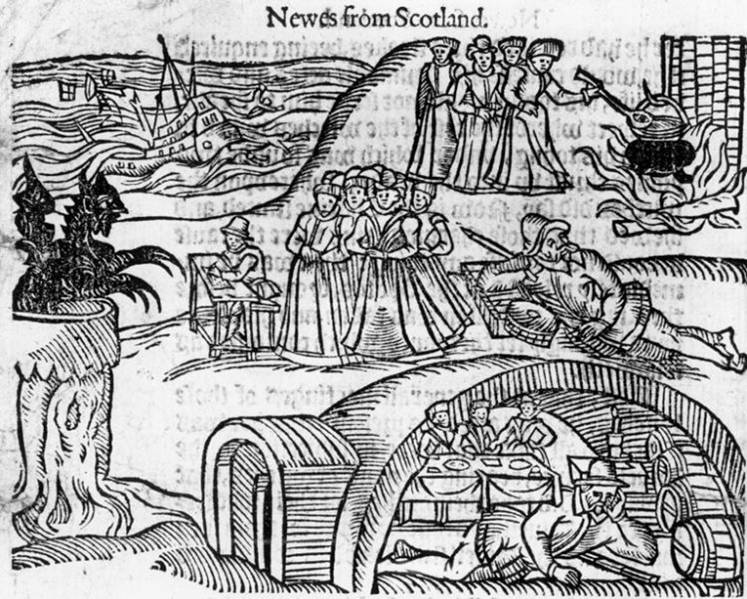
Why would King James VI need a scapegoat? As mentioned in the previous article about Scotland’s witch trials, the king’s voyage back to English territory was overlooked by a storm. His marriage to Anne of Denmark brought him to Scandinavian lands, and on their way back, the storm forced them to take refuge in Norway.
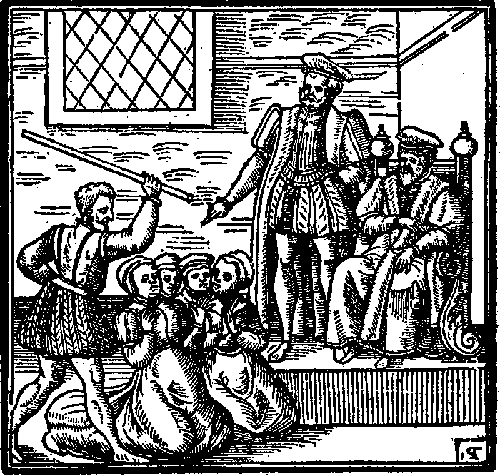
Because the Scandinavian countries were troubled by witchcraft and what they called the ‘dark arts,’ their response intrigued King James VI. The decision made by the king was to arrest anyone suspected of witchcraft. Sure that his voyage home with his wife was a source of witchcraft, he wanted answers.
The arrest of Agnes Sampson tells the story of receiving an image of James VI as a gift from the Devil. The gift would originate from Francis Stewart, the 5th Earl of Bothwell. The Devil was only the messenger. The location of the exchange was Morrison’s Haven near Prestongrange.
How Agnes Sampson’s Torment Began
Agnes’ confessions occurred during torture even though she endured the first wave without confirming their suspicions. She maintained she was innocent for as long as Agnes could, but torture got to her, and she agreed with all statements against her. Agnes fabricated stories only to satisfy her tormentors.
One of her statements stipulates that with the help of a dead cat with corpse parts attached to it, she could drown Jane Kennedy on September 7th, 1589. Letting the charm sink into the sea caused the storm that killed her. She admitted using the same method to raise the storm that threatened King James VI and Anne of Denmark in 1590.
However, there are specific parts of her confessions that somehow raise suspicions. Terms like “contrary wind” used in a particular manner by Agnes show that she had access to unshared knowledge. The king’s ship was escorted, and the fleet would move fairly while the royal ship, though on the same course, would slow down despite the good wind. So, contrary to the others.
The term was often used to describe voyages at sea, but not how Agnes Sampson used it. Voyages with fleets not experiencing the same wind were uncommon in the 1500s. The fact that Agnes could recall a specific moment of the voyage scared the people interrogating her and raised suspicions regarding witchcraft.
The Torture Of Agnes Sampson For Her Witchcraft
In 1590, many accusations of witchcraft spread throughout Scotland. The king had the determination to bring an end to witches. Those who participated in raising storms at sea to drown the king and the queen were in the dungeons. It was time for Agnes Sampson and the others for the interrogations that would usually take place with the king himself.
One of the first things they would do when arresting a witch who ‘confirms,’ usually under torture, is to look for the witch mark. Usually, it would be a blemish or a wart on the skin. They would look for a patch of skin that doesn’t belong and could be anywhere. The person would be stripped down, and an examination would take place.
According to those tortured, Agnes Sampson was the eldest witch. When brought to the king at Holyrood Palace, surrounded by nobles, the examination began. However, the interrogation or examination led nowhere. Agnes denied all accusations. There were no marks or blemishes, and nothing had her admit guilt. She was a good person.
Afterwards, Agnes went to a cell, and torture began. Further examination to find the witch’s mark took place, and the belief was that once a person agreed to witchcraft, the Devil would lick them, creating a blemish on their skin. It would usually be near or on a private part of the body.
For the search to be effective, Agnes had all the hair on her body removed in case the blemish was hidden by it. Her head ‘thrawn’ with a rope as it was the way in Scotland. It is a way to twist hair and slang in the Scottish language. It is torture, described as most grievous, yet Agnes did not change her mind. The only blemish part found was on her vagina. To avoid the ‘thraw’ happening in her privates, she confessed to being a witch and agreed with all statements.
The Execution Of The Scottish Witch Agnes Sampson
On January 27th, 1591, King James VI finally believed Agnes’ guilt during her confessions and interrogations. But it didn’t change the verdict, and the accusation of being a witch remained. She was brought to the scaffold on Castlehill.
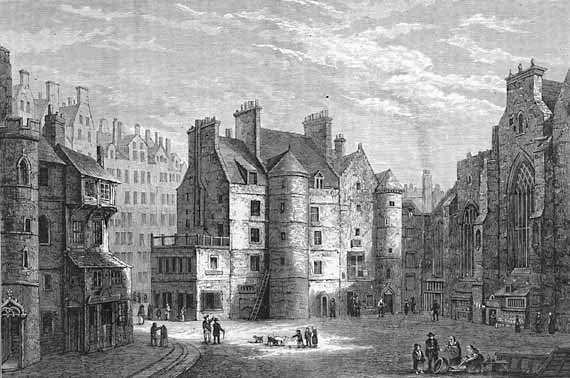
On January 28th, 1591, a garrote awaited Agnes Sampson. A garrote is a torture device that is usually a handheld line of rope, chain, wire, scarf, or fishing line that strangles a person. Once the strangulation was achieved, the body was burned at the stake. It is a misconception that all witches were burned at the stake. Burning witches was a European practice; in North America, witches were hanged.
The legacy of Agnes Sampson went as far as getting a reputation as a good healer. She cured one of the illnesses of John Duncan, and in 1614, Geillis Johnstone, his widow, received accusations of witchcraft. Her crime was to have come in contact with a witch named Annie Sampsone, i.e., Agnes Sampson. The consultation was to cure her husband of illnesses, which Agnes did, but she was a witch.
The Remains Of A Healer As A Witch
In Scotland, people incapable of defending themselves and without any support or education were doomed to perish as witches. Most of them, if not all, in this case, were women. Back then, if you were not royalty or nobility, women had no chance at survival or living in peace.
Women were easy targets throughout history, accused of changing weather and even providing relief when in pain. The outcome didn’t matter because, good or bad, the accusation of witchcraft hung above their head. Women have been very good at science since the dawn of time, creating tonics, elixirs and salves to help for relief. They were good at it because they had no choice.
Agnes Sampson was a good woman and healer and paid for it. Sometimes, it makes us wonder if being kind to others is worth it. It was a risk back then, and she paid the price for it. Kindness should be cherished, not strangulated.
Be proud to be a witch or the daughter of one. Lift your broom and raise your fist, wear your pointy hat and be proud. We’re people, too. We love and heal, too.
 Gothic Bite Magazine
Do you know of other witches who had it as horrible as Agnes Sampson?
LikeLike